12 Best Places to Visit in Bodhgaya, Bihar
With this tour guide, you can easily explore all the Bodhgaya tourist destinations in Bihar. We stayed in Bodhgaya city for 2 days. All the places in Bodhgaya are well-maintained.
We explore all the tourist places within 2 to 5 km. The Mahabodhi main temple is the prime attraction here. After Bodhgaya, we also visited and included the Rajgir tour.
12 Top Places to Visit in Bodhgaya, Bihar
Our Holiday Story – Bodhgaya Tour
We started our journey from Howrah Station. It’s a family tour with fourpeople. The train is scheduled to arrive at Jodhpur at 11.30 pm. We reached Howrah station 1 hour before and reached Gaya at 5.30 am.
We rented an auto-rickshaw for Buddagaya from Gaya station, which cost 200 rupees. The distance between the Gaya railway station and Bodhgaya is 16.8 km.
After we reached our hotel, we had breakfast, rested for a while, and made a Sightseeing list of Bodhgaya tourist places. Then, we started our tour. First, we hired an auto-rickshaw for 200 rupees to Sujata Garh.
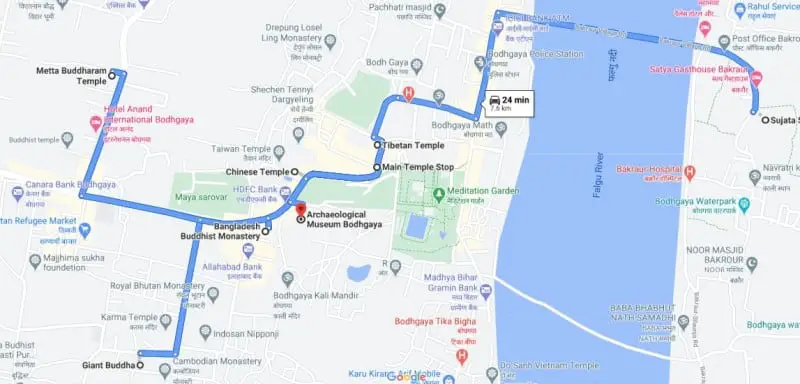
Bodhgaya tourist places – Our route map
First, we visit Sujata Garh. It’s also called Sujata Stupa. This historical site is neat and clean, and it is a sacred place. Next, we went to the Buddha Gaya Museum.
After that, we had a small Tiffin and shopped in the roadside market. We found two beautiful monasteries in that place: Chinese and Thai Buddhist monasteries.
We stopped at both places we visited, and again we hired an auto-rickshaw to go to the Tirupati shopping complex. There, we had lunch at the Tirupati food centre.
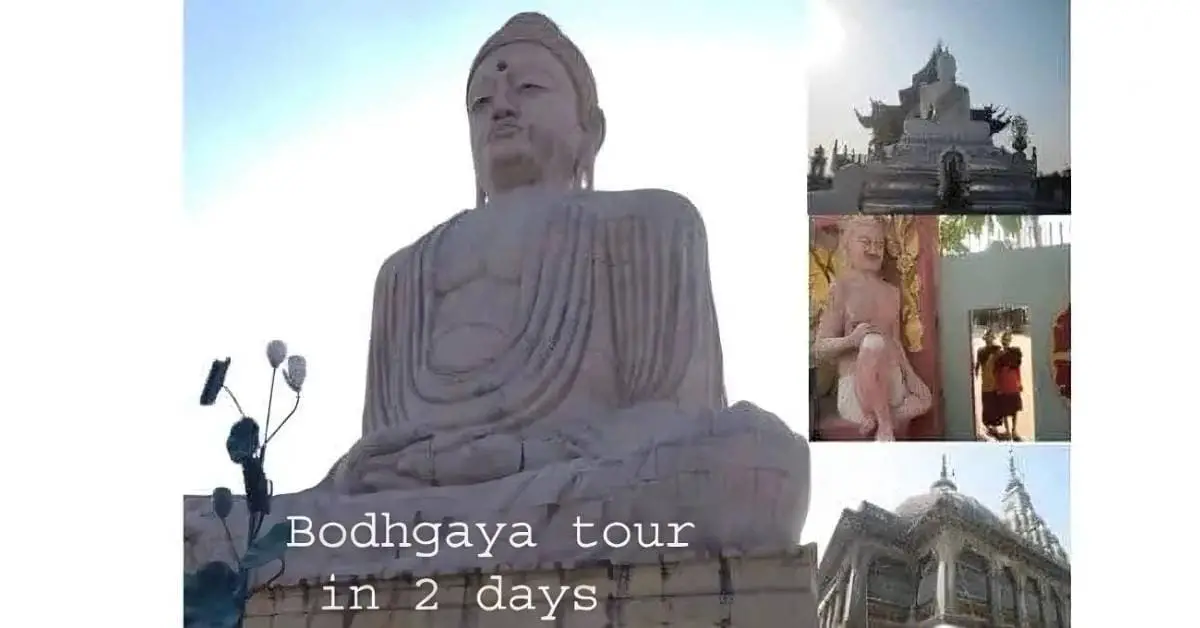
After that, we visited the 80-foot Buddha Statue in Bodhgaya, which is the city’s prime attraction.
From there, we returned to our Hotel in the evening. Since the dining facility at our hotel was not available that day, we arranged dinner at a restaurant. That’s how we spentour first day in Bodhgaya.
1. Gaya tour
The next day, we travel to Gaya. You should include this place in your tour.
Early in the morning, we finished breakfast and started our journey. We booked an auto-rickshaw to Gaya. Here, the main attraction is the Vishnupad Mandir. This temple is situated on the west bank of the Falgu River and is significant to Hinduism.
Spiritual ceremonies are organised after people’s deaths to give peace to their souls. Rituals are also performed there to give their ancestors’ souls peace. This place is called Gaya, after the name ‘Gayaasur’.
According to Hindu Mythology, Lord Vishnu stood on the head of King Gayasur, and the footprints are still there at that place of worship.
Our next stop was Mangla Gouri Temple. On Tuesday, the Temple was overcrowded for puja, so we couldn’t see the idol. We had a good time at the temple, then moved on to the main market in Gaya. It’s similar to any market in Kolkata.
After lunch in the Gaya market area, we booked an auto and returned to our place.
After we rested in the evening, we visited new places in Buddha Gaya again. We visited two Monasteries and a Buddhist Meditation centre; this meditation centre is a Buddhist school where children learn about Buddhist culture and Rituals along with traditional education.
From there, we took a Toto car to the Main temple of Buddha Gaya. Before entering, we had to put our shoes, phone, camera, etc., in the nearby stall. There are many shops where you can put that stuff for free. If you wish, you can carry a camera for a 100-rupee fee.
Lastly, we visited Wat Thai Temple, a Bangladeshi monastery, and a few more monasteries in Bodhgaya before returning to the hotel. The next day, we left Bodhgaya for Rajgir tourism. On the way to Rajgir, we found the village of Dashrath Manjhi.
Read Best Kurseong to Darjeeling toy train travel guide from Kolkata
2. Sujata Garh Sujata Garh
The Sujata Garh is a brick stupa constructed to commemorate the residence of Sujata, the maiden who offered milk and rice to Lord Buddha.
The Garh was established through excavations that yielded an inscription dated to the 8th to 9th century AD. Excavations by the Archaeological Survey of India in 1973-74 and again in 2001-06 have been fully exposed.
It was constructed in three phases from the Gupta to the Pala period. At the ground level, a wooden railing surrounds the ‘Pradakshinapath’. The entire structure was originally plastered with lime. Some of the antiquities were found during excavations. They are displayed in the Bodhgaya Museum, maintained by the Indian Archaeological Survey.
3. About the Archaeological Museum in Bodhgaya
Bodhgaya is one of the most revered pilgrimage centres in the Buddhist region. Lord Buddha attained Supreme Enlightenment at this place. The Archaeological Museum, Bodhgaya, was established by the Archaeological Survey of India in 1956 to better preserve priceless antiquities from the Mahabodhi Temple complex.
4. Bodh Gaya Museum
The museum’s most fantastic attractions are the stone railing, which once enclosed the Bodhi Tree and the Mahabodhi Temple. Made of Sandstone and granite, these pillars belong to the Sunga (2nd-1st Century B.C.) and early medieval (6th-7th Centuries A.D.) periods.
The pillars have sculptured panels and medallions on both faces, representing themes from the Jataka, the life events of Lord Buddha, zodiac signs, folk scenes, etc. Some pillars also bear inscriptions.
The museum houses remarkable sculptures of the Pala period (8th-l2th Cent. A. D.). Significant amongst the Sculptures of the Buddhist faith are images of Lord Buddha in different attitudes, as well as Maitreya, Manjusri, Padmapani, Tara, and Jambhala. In addition, Images of Brahmanical affiliation are also displayed, representing Vishnu, Surya, Urna Mahesvara, Genesa, Kamadeva, etc.
A special attraction of the museum is the display of antiquities unearthed during excavations. The Archaeological Survey of India conducted the excavations at Bakraur village, one km from Bodhgaya.
East of the Mahabodhi Temple, on the opposite bank of the Niranjana River, a brick Stupa built in memory of Sujata, which was discussed earlier, was revealed.
- Entry Fee: 10 rupees per person; free for those under 15.
- Timings: 09.00 a.m. to 05.00 p.m. Tickets sold up to 04.45 p.m.; the museum closes on Friday.
Read Bakkhali Tour Guide
5. The Chinese Buddhist Temple
The white Chinese Buddhist Temple, built in 1945, was styled after Indo-Chinese architecture. The Buddha’s idol is imported from China. In the temple, pilgrims’ names are collected to chant at prayer.
6. Tibetan Buddhist temple near Bodhgaya Mandir, Bihar
The Tibetan Buddhist temple near the Mahabodhi Temple must be included among the tourist places in Bodhgaya. This is the main temple of Tibetan Buddhists, and it has many lodges.
However, this temple has limited access to rooms and lodges. It is under the Himalayan Community of Buddhists. In the temple, I interact with monks; they explain the temple and show Buddha, their prayers, etc.
7. The Great 80-foot Buddha Statue, Bodhgaya
After visiting Tibetan temples and archaeological museums, we visited the 80-foot Buddha statue.
The 80-foot Buddha statue is a unique symbol of Buddha. It’s respected as the sacred place of Buddhists. People come here from all over the world to pay tribute to the enlightened Buddha. The statue also promotes education and symbolises peace and happiness.
The statue is made of pink sandstone blocks, the lotus of yellow sandstone, and the pedestal of red granite.
The Buddha statue is 64 feet tall, the lotus is 6 feet high, and the pedestal is 10 feet high. It was disclosed to the public on November 18, 1989.
Besides the great Buddha statue, there are also 10 statues of the Buddha’s disciples. The statues are made of sandstone. The place is open from 7 a.m. to 12 p.m. and 2 p.m. to 6 p.m. It is very peaceful.
Read Bankura Bishnupur Mukutmanipur Tour | Kolkata weekend sightseeing plan
8. Metta Buddharam Temple
This is the newly built Lord Buddha Temple in white. The temple is on the Sujata Bypass Road in Bodhgaya. It’s a beautiful temple in Bodhgaya, closed on Sunday. It blends modernity, creativity, and culture. This template is decorated with tiny bells. When the wind comes, the bells make beautiful sounds.
9. Mahabodhi Temple Complex at Bodh Gaya
Mahabodhi Temple is the prime attraction in Bodh Gaya, India. On the ground floor, there is a giant gilded Buddha statue. The temple is 60 feet wide and 180 feet high, with its Pyramidal peak. The prayer hall is on the first floor.
The entrance to the temple is through an east-facing gate, styled after South Indian architectural patterns and in the Buddhist mould. All four corners are marked with four towers. The temple walls bear decorative illustrations of the Buddha in several postures, ornamental lotuses, birds, various animals, and the Jataka tales.
This temple is an example of ancient Hindu architecture. The stone walls are from Ashoka’s time. According to another view, the Sungas built this temple (184 to 172 BC).
Hiuen Tsang (635 AD), the Chinese traveller, mentions this palace in his travel stories. The holy image of the Buddha was situated in the temple, surrounded by a gold-plated brass umbrella. In 1877, the British revived it in public.
2500 years ago, Siddhartha, sitting on Bajrashila under a Peepal tree on the banks of the river Niranjana in the Urubilwa village, had practised religious austerity for 49 days to attain spiritual salvation on the full moon day of ‘Baisakh’. After that, the Niranjana River came to be known as Falgu.
10. Bodh Gaya tree
Lord Buddha attained Mahaparinirvan, or enlightenment, under the Peepal tree. It is supposed to be the sacred seat on which Buddha sat and attained spiritual wisdom.
Later, Emperor Ashoka sent a sample of this Peepal tree to Sri Lanka (Anuradhapura) with his daughter, Sanghamitra, and son, Mahinda, as escorts. After the main tree perished, a sample from Snianka (Anuradhapura) was brought to Bodhgaya and installed there.
The Bodhi tree of today is the 4th descendant of the original tree. Buddha used to meditate on the lotus-shaped ‘Vajrayana’ under the tree. Footprints on the stone testify to Buddha’s presence when he became the Buddha, or the Enlightened.
On the branches of the Bodhi tree, devotees fasten pieces of cloth. Buddha, the 9th incarnation of Vishnu, is quite accepted and popular among Hindus.
11. Muchlind Sarobar Bodhgaya
A few steps away from the main temple, I found Muchlind Lake. The serpent king Muchlind is said to have sheltered the meditating Buddha from rain and storm by spreading its hood like an umbrella. Besides this lake, the ancient University of Magadha also came into existence. But today, it is in ruins.
The Mahabodhi Temple may be exquisite in its Godly grace, but Bodhgaya today has become unique. Wealth and artistic embellishments from all over the globe have been pouring in to celebrate the Buddha’s 2500th Anniversary.
12. Wat Thai Temple, Bodhgaya
In 1965, the Thai king built Wat Thai Temple in Bodhgaya. It is the only Thai temple in India and showcases Thailand’s architectural style.
Wat Thai Temple has a beautiful bronze Buddha statue. Inside the monastery, the atmosphere cannot be expressed in words. The Bangladesh monastery Bodhgaya is just beside this monastery.
Are Gaya and Bodhgaya the same?
No, Gaya and Bodhgaya are not the same. Gaya is approximately 15 km away from Bodhgaya. Bus, taxi, and auto services are available from Gaya Station.
What should I buy in Bodhgaya?
You can buy Buddha statues, souvenirs, wooden manuscripts, etc.
What is famous in Bodh Gaya?
Many beautiful monasteries enhance Bodh Gaya’s beauty. The Bodhi tree is a special attraction here. Also, Gautama Buddha composed the Pali here. This place is famous among Buddhist pilgrims.

Very nice article..Like it
Thank you Supriya. After bodhgaya mandir tourism I will publish bodh gaya to rajgir tour details. Just keep in touch..