Puri Jagannath Temple History Miracles Story Myths and Facts
The Shri Jagannath Temple, or Sreekshetra, is the main attraction in Puri, India. It’s a heritage and historical place. During the Puranic ages, the king of Avanti, Indradyumna, a devotee of the Surya God, built the temple as ordained in a dream.
After its destruction, King Jajati Kesari reconstructed the temple. King Anangabhimdev rebuilt the existing model. The history of the Puri Jagannath temple is as follows.
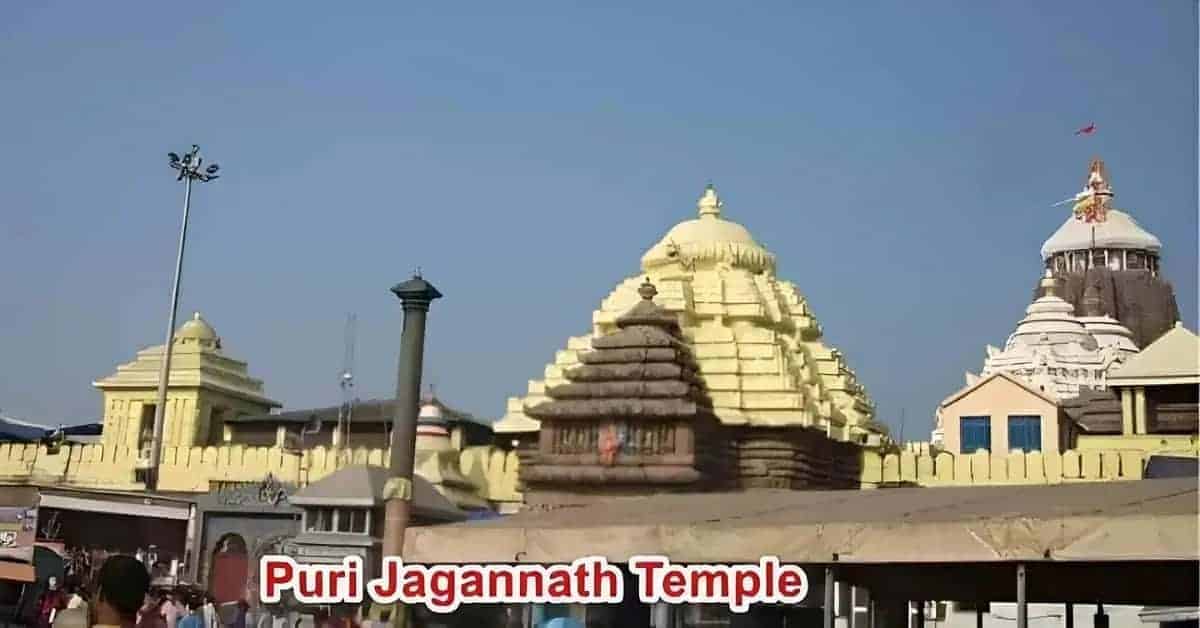
Puri Jagannath Temple History, Miracles, Stories, Myths, and Facts
Puri Jagannath temple
King Anangabhimdev did it in 1198 to express his repentance for killing Brahmins. The construction cost 5 lakh tola of gold. Even after that, the temple flourished under the patronage of the Gajapati Kings. Every temple in Odisha follows the same construction pattern. Biman Natmandir, Bhogmandir, Jagmohan.
Go with Reasons why you visit and love India travel
Jagannath god
The Shri Jagannath Temple, covering 670*640 ft, is surrounded by a 20-24 ft high wall. On four sides, there are four gates: the lion’s gate (Simhadwar), the elephant’s gate (Haridwar), the horse gate (Aswadwar), and the Khanjadwar. The main entrance, in front of the east-facing Simhadwar, is the 34-ft-high Arun Stambha, with the Gaduda on its top.
Both the pillar and motif were cut from the chlorite from Konark in the 18th century by the Kings of Khurda. Two rock-cut lions are guarding the gate. Likewise, the horse, tiger, and elephant are placed by the southern, western, and northern gates. The temple courtyard is up 22 steps; the courtyard itself is 22 ft high. The 424×315 ft wall is rectangular. Even though there are four gates. The Bhogmandir, 58×56 ft, is in the east.
Puri Jagannath temple design
But the gate is the image of nine planets. The Natmandir, resting on 16 pillars, is 80 feet in length and 80 feet in breadth. Jagmohan in the west is 80 x 120 feet. It is also 80 feet in length and breadth and is 192 feet high. Just after the second wall, there is a unique presentation of the Hindu Pantheon.
Viswanath of Kasi, Ramchandra, Jay-Vijay, Badrinarayan, Radhakrishna Batokrishna, Sarbamangala, Kali, Suryanarayan, Pataleswar, Shitalamadhav, Buddhadev, and Gaurangadev mark a conglomeration of all the pilgrimage centres.
At the end of the Natmandir, the remnant pillar leaves against which Chaitnyadev gets lost in his inner world. Devotees still touch Shri Chaitanya’s handprint embossed on the pillar. Hearsay that Shri Chaitanya’s physical presence vanished and merged into the image of the god.
Puri Jagannath temple history follows
On the temple wall are illustrations of men and women in several exotic amorous postures. The ornamental designs and the Pantheon are both attractions for tourists.
The pat-style illustrations of the Purana tales on the walls and the bas-relief works on the temple’s pillars are uniquely original. The variety of matter and the brightness of the colour is remarkable.
Similarly, the illustration of the ten incarnations (Dash avatar) along half of the wall opposite the temple’s inner chamber (Garbhagriha) is interesting. Jagannath, the god, is depicted as the 9th incarnation instead of the Buddha.
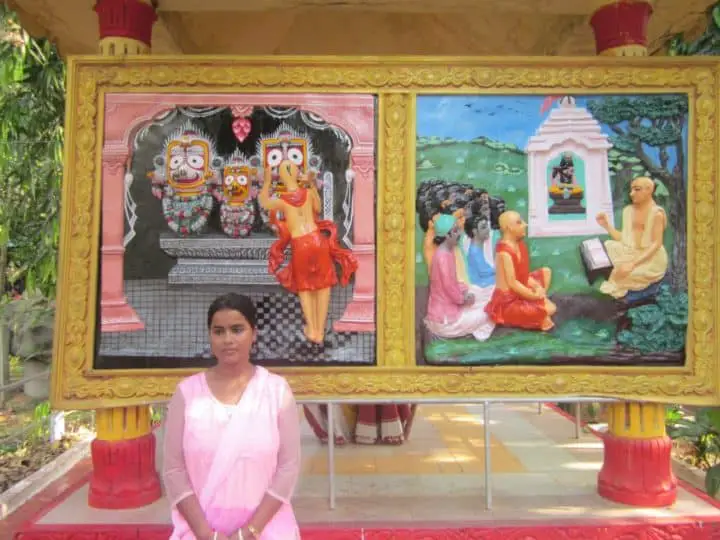
Shri Jagannath Temple
On the bejewelled altar (Ratnabedi) of the main temple, seven images of seven jewels (Satratna) are displayed. The white-faced Balaram, his black-faced brother Jagannath, god with a diamond on the forehead, is with him, as is their yellow-faced sister Subhadra.
Beside them is the Sudarshan Chakra. On the left is the golden Luxmi, on the right is the silver Saraswati, and at the rear is Neelmadhav. The main Deity is made of Brahma wood. Legend has it that Parambrahma, Krishna’s naval, comes floating to Puri from Dwarka as the Brahmadaru.
The year in which there are two new moons in the month of “Ashar” is to remake the Divine image. It’s the Nabakalebar ceremony. To the north of the temple, outside the boundary wall, is the Baikunth (garden) Dham, where the old image of the Deity is to be buried before the remaking of the same starts. Read more about Puri Tourist Spot.
Jagannath painting
According to legend, the son of Brahma, Viswakarma, the father of art and craft, alias Shri Jagannath Dev, was bound by certain conditions once he came to make the image in disguise. It was agreed that the image would be created in 21 days, behind locked doors, in a secret chamber.
The maker started making the image only after he was assured that no one would trespass into his territory for these 21 days unless he opened the door himself. But the queen was too impatient to wait for the full term and opened the door on the 12th day only to find an unfinished idol, whose hands and feet were yet to be made, and the maker gone. The king installed unfinished images in the temple.
Jagannath, the god, is dressed in 21 varieties depending on inner constellations. Dresses are also changed at other times of the day. There are various modes of worship called Atkiya.
The name of one’s four generations has to be registered. Rs 22.50 to 132000 can be given as an offering for the puja. Lesser amounts can also be offered, but Annadaan (cereal offering) is not an Atkiya. There are 6000 priests and 20000 workers who maintain their livelihood from the temple. There are 96 religious distinctions of birth among them.
Read Daringbadi Tourist Places in Odisha
Puri Jagannath Temple kitchen
The largest kitchen in the world is also in this temple. More than 400 cooks cook more than 100 types of Mahaprasad (the Bhog of the gods) in 200 ovens every day. Each day, 70 quintals of rice are cooked for 10,000 devotees. During festivals and special occasions, nearly 2.5 lakh pilgrims and devotees get Mahaprasad.
Mahaprasad can also be bought in the temple’s Anandabazar. There is a variety of Prasad available at different price categories. This Mahaprasad, every morsel that has to be consumed, is never spoiled.
Puri Jagannath temple timings
The temple gates are open from 6:00 a.m. to 11:59 p.m. In the morning and evening, one can buy a ticket to view the deity up close. However, from the new moon in the Bengali month of Asara to the new moon in the month of Jaistha, God remains sick, so it is forbidden to look at him.
Functionally, the image of the image being repainted after the Snanyatra is kept behind the public eye. During the period the god is sick, pictures are kept for the public to represent the Holy Trio. Only Hindus are allowed entry into the temple.
Taking photographs is prohibited. However, enthusiasts can collect pictures from the Raghunandan Library, which is opposite. Non-Hindus can glimpse the Holy premises from this Bhawan (9-12-00 and 16-20-00).
However, the library expects donations for this. The Vishnu chakra and the flag at the peak of the eighth matter tower are visible from a long distance. Devotees, too, can tie a flag after submitting the fixed/ required amount of money to the temple office.
The Shri Jagannath Temple has been renovated for over Rupees 2 crore. 62 religious festivals are held at the Jagannath temple throughout the year.
For more information about Puri and Bhubaneswar, you can read Puri Tourism Guide.
What is the expiration date for Jagannath Puri temple dry Prasad?
The dry Maha Prasad can be stored for a couple of years, but it is best kept in a cool, dry place. At standard temperature, “Khwaja” prasad lasts for up to three months.

Thanks for Sharing this Great information about the Puri Jagannath Temple history. this is much helpful for travelers.
Thanks for sharing information about Puri jagannath temple ….I am searching about it
Thank you
Thanks for sharing Great Information about Puri Jagannath temple.
Really very informative, thanks for sharing this blog
Thank you