Marble Palace in Kolkata and Nearby 8 Visiting Places
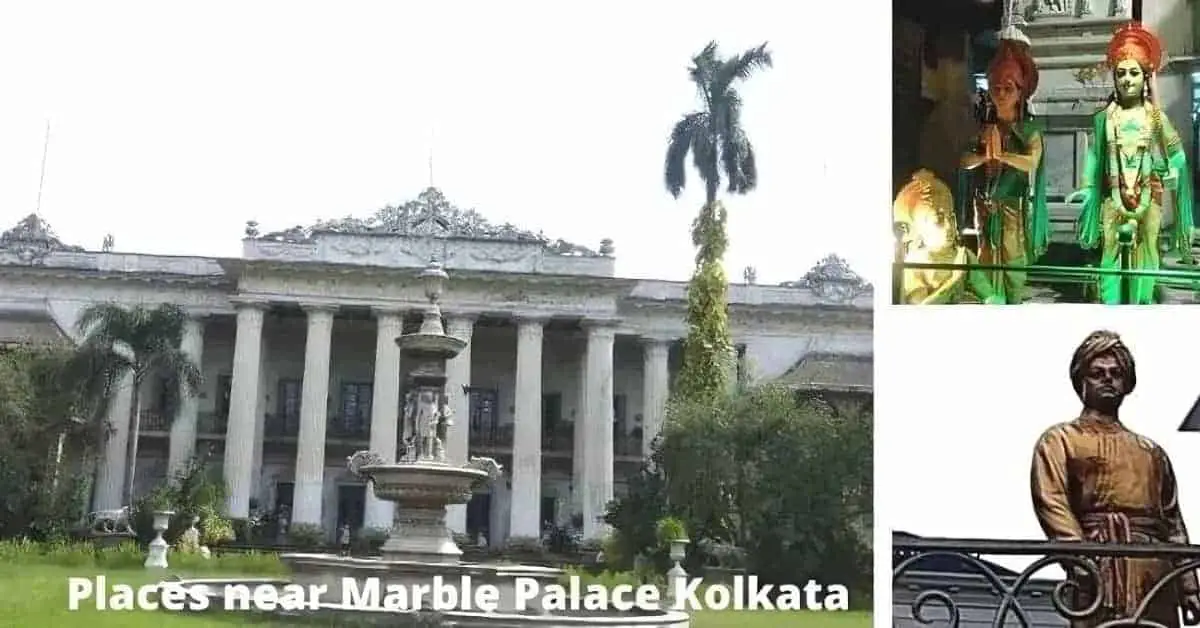
Marble Palace in Kolkata combines elements of Roman epics, Greek mythology, and an Oriental style of Architecture. Raja Rajendra Mallick Bahadur built the museum for his collections in 1835 AD. The stunning marble palace is in Old Kolkata, at 46 Muktaramababu Street, near the Girish Park Metro Station.
Marble Palace in Kolkata and Nearby 8 Visiting Places
Marble Palace in Kolkata
A Jagannath temple is inside the Marble Palace premises. The temple was made by Rajendra Mallik’s father, Neelmani Mallick. Naturally, this temple is older than the palace.
The temple is not open to the public. Only Mallick family members can enter. One part of the palace still houses the Mallick family, while the other part has been transformed into a museum.
The entire Marble Palace is covered with marble and many marble and bronze statues. Rajendra Mallick was very interested in collecting various antiques from the country and abroad.
All of his collections are beautifully shown in the Palace Museum. He collects the 1800s century’s furniture, watches, mirrors, decorated chandeliers, etc. He collects paintings of Peter Paul Rubens, Sir Joshua Reynolds, Bartolommeo Esteban Murillo, and John Opie.
A group of Western intellectuals at the time was surprised to see Rajendra Mallik’s extraordinary collection. With its outstanding collection and tradition, Marble Palace still stands in the light of old Calcutta. The guides show the entire museum tour. Photography is prohibited in the palace. There is no entry fee.
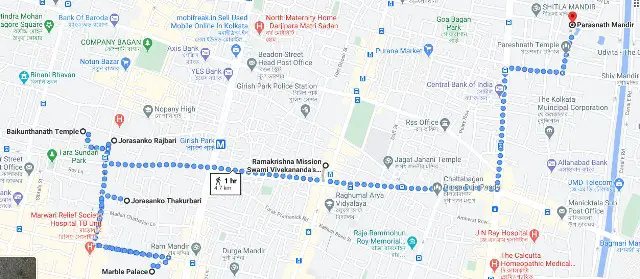
I visited 8 places, including the Marble Palace in Kolkata (North)
You can visit eight more historical places, including the Marble Palace. All sites have ancient histories and stories, and are near the palace.
- Ram Mandir Kolkata
- Marble Palace Kolkata
- Jorasanko Thakur Bari
- Wholesale Marble idol market at Ganesh Talkies
- Baikuntha Temple
- Jorasanko Rajbari
- Ramakrishna Mission Vivekananda Road
- Paresh Nath Jain Temple, Kolkata
- My journey starts at the Mahatma Gandhi Road metro station, and my first visit is to the Ram Mandir.
- Now, my second destination is the most awaited Marble Palace.
- Next, we move to Jorasako Thakur Bari, which is only 2 minutes away from the marble palace.
- After leaving Jorasako Thakur bari, I cross the Ganesh Talkies road; the unique thing about Ganesh Talkies is the wholesale marble idol market. It’s the only market where marble idol is made and sold.
- My next destination is the Baikunth Nath temple.
- Next, my visit is to Jorasako Rajbari. Don’t confuse Jorasako Thakur Bari and Jorasako Rajbari; both are different.
- After coming to Ganesh Talkies crossing, take an auto to Vivekananda Road. Here, you can find the Ramakrishna Vivekananda Mission. And my tour is finished here.
- This is the time for a bonus; if you want to explore North Kolkata more, you can visit the Pareshnath Jain temple.
Take a bus from Vivekananda Road, get off at Hatibagn, then take an auto and reach Gouri Bari. Paresh Nath Jain temple is just a 5-minute walk from Gouri Bari.
1. Ram Mandir Kolkata
Ram temple was established in 1941 in memory of Seth Surajmal Jalan. Inside the temple, the wall was engraved with the story of Lord Ram. Photography is not allowed here.
Ram Mandir Temple timing
The temple is open from 5 a.m. to 12 p.m. and 5 p.m. to 10 p.m. every day.
How to reach Ram Mandir
Ram Mandir is very near the Mahatma Gandhi Road metro station. It is within 2 to 3 minutes’ walking distance from the Mahajati Sadan or the Mahatma Gandhi Road metro station.
2. Marble Palace, Kolkata
Lord Minto gave the Marble Palace its name. It was built in “Gothic style architecture ” on 12 acres of land in 1830, using 126 different types of marble.
It is said that 5,000 artisans laboured for five years to complete the building. The visitors are stunned by massive, original paintings by renowned artists, marble statues, fountains, 82 decorative antique clocks, and beautiful glassware.
The collection has been made even more valuable by Rubens’s paintings, which depict Catherine’s wedding, the Last Supper, the Battle of the Amazons, horse care, and more. Magnificent treasures from 90 countries worldwide have genuinely enhanced the museum’s glory here.
There are artificial mountains, parks, Kolkata’s oldest private surviving zoo (1856), and shaded palms in lush green surroundings. Six marble sleeping lion cubs enhance the charm. On the northwest corner, a mini-lake is situated, and a fountain is placed in the middle of the lake. The fountain looks like God emerging from the Greek epic.
During the terrible famine of 1865-1866, he helped many people and donated to aid those suffering from food shortages. For that, the British awarded him the title of “Ray Bahadur.”
In 1878, Lord Littan honoured him with the title of “King,” with a diamond ring.
What to see in the Marble Palace, Kolkata
Raja Rajendra Mallick’s statue is on the right side of the Marble Palace. Next, I went to the main building (first floor) with the guide and proceeded to the left.
The first surprise is a beautifully designed marble floor. Then, on the right-hand side, the Billiard board is placed. After entering the billiard room, many marble and bronze statues are placed.
Then proceed to the house of Maharani Victoria, which features a giant statue of a woman. It is made of single rosewood and glassware, and the Carpet Design ceilings are also magnificent. Rajendra Mallick brought a wooden statue of Medusa and Hercules and a beautiful table clock from London.
Marble Palace Reception Hall
Then we went to the Reception Hall, which has a Marble floor. In the lobby, there is a large, comfortable sofa, a long, square table, two tall vases, and many paintings on the walls. Four statues describe the four seasons: Autumn, Spring, Winter, and Summer.
There is a stunning piano, the first piano in India. It is played on Monday and Thursday to maintain the correct tone. There is a vast brass Dhunuchi (ধুনুচি) and a Setar (সেতার ), which Pandit Ravi Shankar played. After striking, magnificent ivory (elephant’s) teeth look huge and attractive.
Then, I came out of the Thakur Dalan. It is a unique combination of Indo-European Mythology. I found a sculpture of Surpanakha (সুর্পনখা) and Laxman (লক্ষণ) among other Greek and Roman goddesses on the walls. In this Thakur Dalan, I found “Maa Kali” and Saraswati.
However, no outside visitors are allowed to enter. Many Victorian-style iron chairs are placed. Four statues represent four countries. In ‘Thakur dalan,’ pigeons fly everywhere. On one side of the Thakur Dalan (ঠাকুর দালান), many bird cages are made, including Parrot, Macao, Badri, Muniya, Kakatuya, and Nilkanth.
Then I visited the second floor of the marble palace in Kolkata
The stairs are made of Segun wood and have a beautiful design. Carpets are spreading on the stairs. In one step, I saw the magnificent Belgium Mirror. Even today, it gives a proper reflection. My eyes were stuck on the wall when I visited the painting of Raja Ravi Varma.
Look up and see large hand-painted oil paintings. Here are some rare pictures of the famous Italian artist Rubens, which are part of the collection.
I found a clock beside me and realised it was a Grandfather Clock. The same pair of Grandmother Clocks is on the ground floor.
Here are many other paintings, including 2 3D paintings. The one name is – Belly Dancer.
Next, we went to the dance room or ballroom. In front of the room, a giant “hookah” is placed. It can be used by 14 people together.
Two large Belgian glass mirrors, wrapped in golden frames, hung on the walls of the dancer’s room, or Nachghar’s (Dancing room). There were also many chandeliers on the ceiling and walls, still lit by candles.
Their Porcelain vases are placed, brought from China and Japan. You can find India’s giant flower vase here.
After we move to the painting house or the Rubens Room
There are paintings by foreign artists and by Indian artists, including Sir Joshua Reynolds, Titian, Murillo, John Opie, Shashi Hesse, and Bijay Chandra Dey.
Some of the significant photographs in this room are “Marriage of St. Catherine,” “Martyrdom of St. Sebastian,” “Minerva giving the loving cup to Apollo,” “The Return of Ulysses” by Ruben O Murillo, Sir Joshua Reynolds’ Venus & Cupid, and “Child Hercules & Serpents.”
Marble Palace Zoo, Kolkata
India’s first zoo was established in 1856 in the marble palace area. It still exists with some birds and deer. It’s India’s first private zoo, and its cages are about 250 years old. These zoo cages received the honour of “Heritage Cage.”
On the right side of the marble palace, there is a pond and a zoo. There are deer, ducks, and various birds. Many seating arrangements are made with marble stones.
- Address: The Marble Palace, Kolkata, is located at 46 Muktaram Babu Street.
- Nearest metro station: The Mahatma Gandhi Road metro station and the Girish Park Metro Station.
- Timings: The Marble Palace open from 10 a.m. to 4 p.m., except on Monday and Thursday, when it is closed.
Marble Palace Kolkata Permission
For permission to enter the palace, you must visit the West Bengal tourism office near the Tea Board. Carry your Voter card or Aadhar card. They’ll make a permission letter. When entering the marble palace, you must present your permission letter.
West Bengal Tourism Office Address is Tourism Department, Government of West Bengal, 2, Brabourne Road, 4th floor, Kolkata – 700 001. Phone – 033-2225 4723/4724/4725; 2225 4565
Marble Palace, Kolkata, entry fee is Nil.
Read Biswa Bangla Gate New Town | Hanging restaurant Kolkata [Opened]
3. Jorasanko Thakur Bari
The Jorasanko Thakur Bari is Kolkata’s pride. It is situated 2 to 3 minutes from the marble palace. At the main entrance of Jorasanko Thakur Bari, Kolkata, Rabindra Bharati University is established. The university is built on the front part of the house.
Prince Dwarkanath built this house in the eighteenth century. According to the Jorasanko Thakur Bari history, he built it in 1785 AD on the land given by the Sarthaparibar of Barabazar. The area is approximately 3500 square meters. The inner part of the house has been transformed into a museum. Photography is prohibited inside the Jorasanko Thakur Bari Museum.
Only outside the house can a photo be taken for 50 rupees. Jorasanko Thakur Bari’s atmosphere is very peaceful and pleasant. The picture explains the memorable moments of Rabindranath’s life in the place.
Jorasanko Thakurbari address
The Jorasanko Thakur Bari address is 6/4 Prince Dwarkanath Tagore Lane.
Jorasanko Thakurbari Kolkata Opening Timings
The Jorasanko Thakurbari museum timings are Tuesday to Sunday – 10.30 am to 5.00 pm. The last ticket will be issued at 4.30 pm, and Monday is closed.
Light and Sound Show Timings
- November to January
- 6:00 pm – 6:40 pm (Bengali)
- 7:00 pm – 7:40 pm (English)
- February to June
- 7:00 pm – 7:40 pm (Bengali)
- 8:00 pm – 8:40 pm (English)
Jorasanko Thakur Bari Kolkata Entry Fees
- Adults: 10 rupees per person
- Student:s 5 rupees per person
- Foreign Tourist:s 50 rupees per person
- The light & Sound show costs 10 rupees per person
- For taking photography only outside of the house, 50 rupees (per camera)
4. Wholesale Marble idol market at Ganesh Talkies
Do not skip the Ganesh Talkies stone idol market while crossing the road of Thakurbari. It is the only market in Kolkata that makes stone idols.
Read more
- Kolkata Dakshineswar Kali mandir and Belur math Adyapith with Skywalk
- Metcalfe Town Hall | Ami Kolkata museum exhibition timings West Bengal
- National Library Kolkata India
- Alipore Zoological Garden, Kolkata
5. Baikuntha Temple
While planning to visit the Marble Palace or Jorasako Thakur Bari, you should visit this beautiful temple in the area, which features South Indian architecture.
The Baikuntha Temple was built in the 1960s. The entire Ramayan is engraved on the temple entrance. In this temple, you can see lord Baikuntha with Sridevi and Budavi. All deities were carved from stone, and temples were built of white marble and granite.
Devotees are coming daily in the morning and evening. Regular prayer happens at both times.
Baikunthnath Temple timing
The temple timing is 5.30 am to 11 am and 4.15 to 8.45 pm.
How to reach Baikunth Nath Temple
The best way to visit Baikunth Nath Mandir in Kolkata is to reach the Girish Park or Mahatma Gandhi metro station and walk towards Ganesh Talkies.
6. Jorasanko Rajbari
Don’t confuse Jorasako Thakur Bari and Jorasako Rajbari. Both houses are different. Jorasako Rajbari is 5 minutes away from Jorasako Thakur Bari.
This Jorasako Rajbari belongs to the Roy family. In north Kolkata, towards Chitpur, the first Bengali family residence is Rajendra Narayan Roy’s family, among the old Bengali residents. The residence is known as Jorasanko Rajbari.
The house is three hundred years old and has an excellent colonnade on the front and a porch decorated with cast-iron grips. Durga Puja is a unique attraction here.
Jorasanko Rajbari Address
329, Rabindra Sarani, Ahiritola, Ram Bagan, Kolkata – 700006
How to reach Jorasanko Rajbari
While visiting Marble Palace and Jorasako Thakur Bari, visit this ancient house. It is 5 minutes away from Jorasako Thakur Bari. The nearest metro station is Girish Park. The most immediate bus stop is Jorasako/ Ganesh Talkies.
Visit Most famous places in Kolkata
7. Ramakrishna Mission: Swami Vivekananda’s ancestral house, museum, and cultural centre
Swami Vivekananda was born on 12 January 1863 in this house. It’s become a museum now. Visiting the ancestral home of Swami Vivekananda is a beautiful experience. Kolkata Municipal Corporation has declared this house a Grade-I Heritage Building.
Swami Vivekananda’s childhood memories are depicted quite nicely through pictures and working models. Photography is prohibited inside the museum.
Read New Town Eco park | Seven Wonders Kolkata
Ramakrishna Mission Museum at Vivekananda Road timings
The museum is open from Tuesday to Sunday from 10 am to 12.30 pm and 2 pm to 5 pm, and it is closed on Monday.
Ramakrishna Mission at Vivekananda Road address
The house is situated at 105 Vivekananda Road, Kolkata 700006. West Bengal. India.
8. Pareshnath Jain Temple, Kolkata
The Pareshnath Temple in north Kolkata was built in 1867 by Roy Badridas Bahadur Mukim.
In this area, you can find four temples:
- One is the main temple, where Jain’s 10th Tirthankara is situated
- On the south side of the Pareshnath temple is the Chandra Prabhuji temple
- In front of the main temple are the Jain Dadaji Garu and Kushalji Maharaj’s temples.
- The north side of the main temple is Mahavira’s temple.
Paresnath Jain temple is a very decorative and gorgeous temple. Here, you can see a well-maintained garden, European statues, and wall engravings featuring valuable metals and stones, such as coral, crystals, pearls, rubies, and diamonds.
A ghee lamp has been burning in front of Sri Sitalanath Ji since 1867. When you visit this temple, don’t forget to see the diamond on Sitalanath Ji’s forehead.
Pareshnath Temple Kolkata Timings
The Pareshnath Temple’s opening hours are 6 a.m. to 11 a.m. and 3 p.m. to 7 p.m. on all days.
How to reach Pareshnath Temple
Take a bus or an auto from the VK road and get off at Hatibagan. After changing the auto, reach Gouribari, five minutesfrom there. You can come from Sealdah / Ultadanga/ Shyambazar or Sovabazar, and the nearest stoppage is Bangiya Sahitya Parishad. The nearest metro is Sovabazar or Shyambazar.
How do you get to Marble Palace?
Mahatma Gandhi/ Girish Park metro station is a 5-minute walk from here. Also, 5-minute walking distance from Jorasanko Thakurbari.
Marble Palace is approximately 2.3 km away from Sealdah Station. By bus 1. 234/1 (from Sealdah). 2. 222 (From Esplanade) reach Mahatma Gandhi Road.
When was the Marble Palace built?
In 1835, Raja Rajendra Mullick Bahadur built the marble palace at Machuabazar, Kolkata.
What attractions are near Marble Palace, Kolkata?
Jorasako Thakur bari 2. Baikunth Nath temple 3. Ramakrishna Vivekananda Mission, etc.
How can I get a permit for the Marble Palace in Kolkata?
You need to get permission from the West Bengal tourism office, which is near the Tea Board. Carry your Aadhaar/ Voter card.
